REPORT ON “PREVENTING TERRORISM AND CYBERCRIME THROUGH PRACTICING ISLAMIC STUDIES IN COMMUNITY”
15th March, 2020
Jamia Qurania Islamia Kamrangir Char Madrasah (JQIKCM)
Kamrangir Char, Dhaka-1000
The most immediate and measurable impact of terrorism is physical destruction. Terrorists destroy existing plants, machines, transportation systems, workers, and other economic resources. Terrorism and terrorist activities is a global problem and threat to all nations directly or indirectly irrespective of religion, race, culture or geo-location. The Government of Bangladesh (GOB), over the years, has demonstrated strong will and made relentless efforts in preventing the terrorist groups from operating in Bangladesh.
Despite of having government’s strong position against terrorism, some extremist religious groups have shown their presence in Bangladesh. In this circumstance, a dedicated specialized unit under Bangladesh Police is inevitable to counter all sorts of terrorism. “Counter Terrorism and Transnational Crime” unit under Dhaka Metropolitan Police has started intelligence-led proactive investigation in terrorism and transnational crime, arrest criminals, collect criminal intelligence and keep the terror suspects under surveillance and finally stop such activities with the help of people. Subsequently, government and different non-government organizations in Bangladesh are working together for preventing this alarming issue.
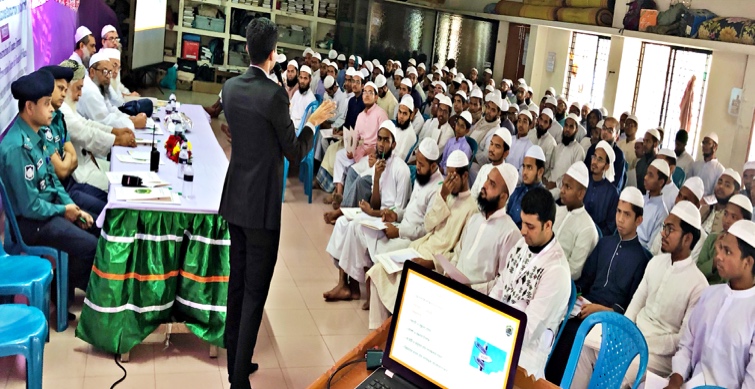
As a chapter of this promising approach to prevent terrorism from our country Community Development for Peace (CDP) has organized a daylong program in Water Garden Convention Hall closed to Jamia Qurania Islamia Kamrangir Char (JQLM) Madrasah, Dhaka on 15th March, 2020 funded by Counter Terrorism and Transnational Crime. A series of lectures were delivered with diversified topics. The program was introduced with the holy Quran recitation. Two surreal Islamic songs were sung by two of the students from the respective institution. The whole program was divided into seminar and workshop. More than 250 students were present in seminar and the workshop was conducted with 100 participants.
Session 1: Seminar
Seminar was designed with a series of lectures by different academic backgrounds. The interactive seminar was followed by lunch. The motivational and encouraging lectures were the fuel of the seminar.
Mohammad Julfiker Ali, Director of Community Development for Peace (CDP) welcomed the seminar with the background of their organizational motto to work for raising awareness against radicalism. He mentioned the contribution of the government and organization approaches to cope up with the ultimate scenario of the concerning issues of terrorism. CDP is working for ensuring a better community where education should be mandatory for all. Besides, a community based disaster risk reduction (DRR) program is also playing a vital role to engage youth community to help country and make a peaceful society.
Md. Nazmul Islam, Assistant Commissioner of Police, Counter Terrorism and Transnational Crime (CTTC), Dhaka Metropolitan Police delivered the key note speech. In his lecture, he tried to mention the risk of extremism in our society. Besides, he mentioned the root causes of the origin of terrorism and the impacts in our society. People who are in the age level of (15-30) years old are quite vulnerable for being target of terrorist as well as militants. Study says that lack of good parenting is the vital reason for terrorism.
In our society the unemployment issue is also the key factor for promoting terrorism. Terrorist has no color, no religion they are the diseases of our society. In the cyber domain terrorist leveraged web-based tools to replace a once centralized command and control structure. He mentioned the inspiring quote of young girl of Pakistan, “With guns you can kill terrorists, and with education you can kill terrorism.” ― Malala Yousafzai.
Bangladesh is one of the countries which is facing threat by militant. The law enforcement situation, democratic practice, injustice and discrimination among the different classes are setting fuel to become people radicalize. To get rid of from this situation only religious study would not enable to change them. Students should be involved with co-curricular activities. Police are the friend of general people and without the co-operation of all classes of people it would be tough to prevent terrorism. To accure facilities general people will always get police by pressing 999 easily.
Md. Hafiz Al Asad, Additional Deputy Commissioner of Police, Counter Terrorism and Transnational Crime (CTTC), Dhaka Metropolitan Police, explained very nicely about the religious quote and their applications in our society. On his lecture, peoples’ myth on the very sensitive issue of “Zihad” and “Terrorism” were nicely described. He mentioned about the constitution of Madina that none can go for personal Zihad.
Zihad is completely a decision of a nation. He brought out a few common reasons of the narrative gap of the community and madrasha students about a specific issue. The traditional cross fire issue should be banned. Maulana Saidur Rahman, Jamia Nureya Islamia Kamrangir Char Madrasha, Dhaka, It is no exaggeration to say that Islam and violence are contradictory to each other. A small section of misguided Muslims are indulging in activities that are against the teachings of the Quran and tarnishing the image of the religion. The concept of Islamic violence is so obviously unfounded that it stands rejected.
The fact that violence is not sustainable in the present world is enough to convince one that violence, as a principle, is quite alien to the scheme of things in Islam. Islam claims to be an eternal religion and such a religion cannot afford a principle in its scheme which will not be sustainable in later periods of human history. An attempt to bracket violence with Islam amounts to casting doubts upon the very eternal nature of the Islamic religion.
Dr. Saber Ahmed Chowdhury, Associate Professor, Department of Peace and Conflict, Dhaka University, he stared his lecture with a very bold speech “ students are not involved in terrorism because who are involved in terrorism he/she should not be considered as student”. Islam doesn’t allow any extremist activity. The people who are the believer of Islam can’t get involved with any terrorism. To live in a civil society all of us should know about the common law. To build a peaceful community people should work together. Public participation can be a strong weapon to fight against terrorism.
Specific courses should be included to established peace in our community. The most important place for spreading proper religious education is Mosque, Temple, and Church from respective religious perspective. In any religious meeting, respective people should encourage the youth generation about the betterment of the society. Due to the social barrier, religious personalities can’t speak more about the terrorism. “Islamic Extremism” it’s a western term of influencing the whole world. Religious practices have become reduced in policy level among nations. In civil society proper explanation should be published.
Advocate Saimun Reza Talukder, Senior Lecturer and Assistant Proctor, Department of law, Brac University, delivered his speech with the historical background of the different terrorists and their physical attitudes and tendency to grab the young people. He mentioned the ICT Punishment Act, under this act any cyber offences whose are interrelated both the terrorism and also the anti human activities would be punished. He addressed social media as Digital Cocaine. His cyber crime explanation part was so brilliant that specified all reasons very clearly.
Maulana Abdul Halim Saikul Hadish, Muhaddis, Jamia Islami Madrasah, Dilu Road, started his speech with a proverb “Shape of our fingers changes with the variation of our food items”. Muslim should control his soul to stay far from greediness, jealousness, and all kinds of bad manner in our society. Moral education should be practiced in every sector of our society. To know our almighty in deapth can enable us to get rid of terrorism, extremism andviolence activities.
Maulana Mohammad Elias, Muhaddis, Jamia Nureya Islamia Kamrangir Char Madrasha, Dhaka, Islam is the religion of peace. Over billions of people around the world are followers of Islam. There can be no greater argument supporting Islam as a religion of peace than the name of the religion itself. ‘Islam’ literally means peace, therefore, it seems quite unnatural that a religion that names itself peace can teach or preach something that is violent or full of aggression.
Allah Almighty in Quran has encouraged the establishment of peace and has told the followers of Islam to be moderate in their behavior and adopt the qualities of kindness, love, and respect for others. There are so many Hadith on the importance of peace in Islam that we will discuss in this article.
Session 2: Workshop
Alike the seminar, workshop was also conducted by CDP team. Relevant 10 exclusive topics were provided to the workshop participants. Participants were separated into 10 groups each having 10 members and each group members had to present their thoughts on specific topics. An interesting question answering session was also there to make it more live and exciting. Participants presented according to their no of table.
Table 1: Participants’ of this table was very energetic and pragmatic. They mentioned reasons behind terrorism because of lack of institutional knowledge on Quran education. In moral reason, they mentioned lack of religious education, misinterpretation of religious belief, maintaining distance from religious scholars. On the other hand, lack of corruption, dirty politics of recruitment are responsible for enhance the young students towards radicalism.
Table 2: In treditional education need to include religious aspect to establishing peace in our society. Therefore, the moral education is must be included in Madrasah education and mainstream education. It is important to educate young people about the phenomenal activists and it’s impact in social life and carrier. Also shown character to fight against all odds and champion the right causes to bring revolutionary changes.
Table 3: In counry like Bangladesh dirty politics are spread out day by day. Terrorist organizations are using social media platforms for recruiting, training and communicating with their followers, supporters, donors, as it is cheaper, easier, faster and effective method of communication. The members of the terrorist organizations are spreading their ideological thoughts, propaganda and their activities. Nowadays students are getting addicted on social media rather to become socialized.
Table 4: Moral education enables children and young people to explore the world’s major religions and views which are independent of religious belief and to consider the challenges posed by these beliefs and values. It supports them in developing and reflecting upon their values and their capacity for moral judgment. Through developing awareness and appreciation of the value of each individual in a diverse society, religious and moral education engenders responsible attitudes to other people. Team table 4 agreed that “try to be a student not examinee”.
Table 5: The most important findings have been come out from the discussion of this table that “promote religious education one day per month in every institution” There are many areas in which one could educate a person in order to prevent violence. One way is through impulse control and anger management classes, practicing moral education. Students need to keep in touch of the current affairs of the world. It is important to note however that having proper role models can be key to young adults when they are attempting to attain these skills in a class.
Table 6: Nowadays the basic knowledge of Quran is not practicing in our society. Students are getting involved virtual media rather than to get increase social involvement. In every institution religious education should be established. Family should rear their children following the right knowledge of religious education. Student who come from the madrasha background he should be encouraged to practice in mosque as Friday lecture.
Table 7: Cybercrime is a crime in which a computer is used for a crime like hacking, spamming, etc. For instance, cybercriminals use the internet and computer technology to hack user’s personal computers, smart phone data, and personal details from social media, business secrets, national secrets etc. One of the best ways to stop these criminals and protect sensitive information is by making use of inscrutable security that uses a unified system of software and hardware to authenticate any information that is accessed over the internet. Students don’t even know about the bitter consequences of it when they are taking the modern technological benefits. Awareness is badly needed for securing cyber security.
Table 8: Cyber security protects the data and integrity of computing assets belonging to or connecting to an organization’s network. Its purpose is to defend those assets against all threat actors throughout the entire life cycle of a cyber attack. Cyber security experts need a stronger understanding of these topics and many others, to be able to confront those challenges more effectively. To get rid of being affected by cyber crime cyber security should be ensured.
Table 9: Disruption of terrorists on social media involves reporting and taking down of radical elements and acts of violence, whether that is radical accounts or posted content that breaches community safety and standards. All posts should be verified before posting. Besides, those who were punished by their activity should be published on social media, so that others can be aware of involving radicalism. Everybody should be aware of getting rumor, the boys explained very strongly.
Table 10: In our national law religious education practices should be mandatory for all. Terrorism Prevention programs can be effective disruption tools if used at the appropriate time within the cycle of violence. Appropriate mental health and social service professionals can use a whole-person evaluation approach toward an individual who may be considering violent actions as a solution to his/her grievances. In other words, professionalization of existing intervention processes entails law enforcement working more effectively with mental health and social service professionals. Information reported by family members or other loved ones may require sensitive handling to preserve the country’s better condition. Ministry of Religious Affairs and Ministry of Home should take actions against the extreme group of people.
Therefore, seminar and workshop outcome signify that public opinion strengthens or weakens terrorists and extremists. All ages of people in our country don’t want to see the terrorism activities in this homeland. To get a terror-free country this awareness should be continued. Before announcing the closing, remarks gifts were given to the guest speakers and respective teachers of that program.